Showing posts with label Lesser Sand-plover. Show all posts

Sunday, August 25, 2024

Tibetan Sand-PloverS!

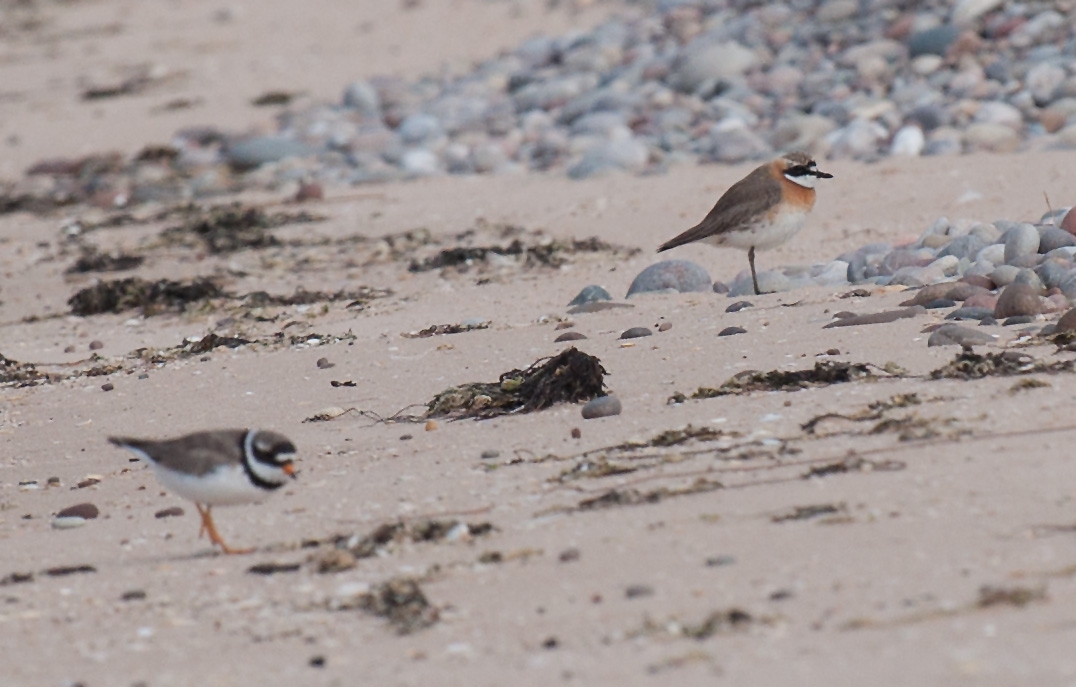
So this is how it went: Saturday morning I get back from my weekly circuit of Hulda Reservoir with Piki et al. I take a look on eBird to see if anything interesting has come up. When I check a checklist from Hamaapil by Ilan Nissim Moriya, I am intrigued to see his report of two Greater Sand-Plovers. GSP is strictly coastal in Israel, so this is very unusual. I drop Ilan an email, asking for further details (I'm an eBird reviewer). Dan Sharon sends me via WhatsApp this photo, that knocks me off my chair:


Then Dan tells me it's Ilan's photo and I figured it out... According to them, this was one of three (not two) juveniles present, that all looked the same. That sounded totally unreal. Tibetan Sand-Plover is mega in Israel, with six or seven previous records, so three together?!? How can that even be real? I asked Ilan for further photos, and after lunch he sends me a bunch of convincing photos. I ask Ilan to release the news out as probable Tibetan Sand-Plover and a big twitch (in Israeli standards) develops. The first twitchers quickly arrive on site and confirm my tentative ID. I skip my traditional Saturday afternoon siesta and go with Piki to twitch them. 50 minutes drive, not too bad. I have seen two in Israel before, but not since 2013, and three together!!! When we get there several twitchers formed a bit of a queue. 

The fishpond is full of birds but we ignore them as we are very focused. The sand-plovers are on show immediately. Piki is smiling - it's a lifer for him. The birds are very close and tame but we are at the back of the queue, watching from inside the car into the sun. I drive around the pond and position us at the opposite corner. Light angle is slightly better but we are quite distant. I am not comfortable in the car with the angle and the heat, hence the mediocre documentation. There are much better photos available. We appreciate their small size and short, stout bill. I discuss on the phone their intricate ID features with other birders watching them out of other cars. A little bit of doubt is raised about their identification, because of their fairly long legs and slightly larger size of two of the three. However, I leave the site feeling confident they are Tibetan Sand-Plovers. 

Sweety

In different light conditions


With Little Stint

Three Tibetan Sand-Plovers together

The doubt is dissolved eventually, especially after two of the three birds were trapped and ringed today by a local ringing group doing a pre-planned shorebird ringing session. Their biometrics confirmed they are Tibetan. Bingo.

Saturday, April 10, 2021

Eilat plover mystery

 On Thursday I spent the morning in Eilat with Jonathan, Arad and Rony. In fact we left home on Wednesday before midnight, and made our way down south picking up some night birds along the way. None posed for photos, but this Desert Hedgehog, the largest of Israel's three hedgehog species, was quite lovely:


At first light we started birding at Seifim Plains. I had quite high expectations from this site - reports from recent weeks described the place as heaving with birds. It was very quiet in fact - not many larks singing, few migrant wheatears (no sign of the pied seen there the day before) - eBird checklist here.

Hooded Wheatear 2cy male

At IBRCE things were not much busier - a significant exodus of birds happened the night before... Nothing special to report on the bird side, some year birds (Levant Sparrowhawk, Rufous-tailed Scrub Robin, Red-necked Phalaropes) - eBird checklist here. This fine Schokari Sand Racer was very cool to watch:


Then we moved on to KM20 saltpans for the disputed sand plover. It was waiting for us at the entrance to the saltpans, and showed well. This bird was found by Shachar Shalev on March 27th, and it's ID isn't final yet (IMO). Our initial reaction when seeing the bird, especially the long bill, was 'whoa, this can't be a Lesser Sand-Plover'. But then, at closer inspection, we started to have other thoughts. Re size, though slightly larger than Kentish Plover, it was certainly in the 'small and delicate plover' camp, comparable with kentish and ringed, rather than 'beast plover' camp. Then, in all angles, it's seemingly clean legs were black or blackish, not green. With no signs of moult into summer plumage whatsoever, I find this a solid candidate for Lesser Sand-Plover, but happy to be proven otherwise. 


Photos by Rony Livne:


Digiscoped photos and video by Jonathan Meyrav, taken through Swarovski Optik ATX85:


I agree it has a long legs, large head and long bill, but from my experience, there's so much variation in both species in these features that I'm not sure how relevant they are. Same for leg extension and wingbar pattern. See my insights on identification of Lesser and Greater Sand-Plovers in Kenya here and here.

The mental process regarding the identification of this bird reminds me of the process we went through with the 2010 Lesser Sand-Plover. When seeing the photos taken by the finders, we were eluded by the longish bill. It wasn't until we saw the bird in the field that we realised how small it is. 

It is interesting that almost everyone who saw this bird identified it as Lesser Sand-Plover, while those identifying it from photos say it's a greater. In any case, this is a great bird to study - more to come!

After we had enough of the sand plover, we continued to check the saltpans that were packed with shorebirds, gulls, wagtails, pipits and generally very lively (eBird checklist here). It was entertaining to watch a variety of Western Yellow Wagtails chase after swarms of shore flies (Ephydridae) coating the banks:


feldegg-type (with some green stuff on head, and flies on back)


Typical feldegg with more solid black head

thunbergi? Or dombrowski? Very small supercilium on a blue head

Typical flava with more developed supercilium

On the way home we paid a quick visit to the Black Scrub-Robins in Kibbutz Samar, this one ringed as part of a study on their movements and colonisation:


Thanks to Jonathan, Rony and Arad for the company, vibes and use of photos.

Thursday, August 1, 2013

Lesser Sand-plover - check!

An atrifrons Lesser Sand-plover was found by Irad Solnik on July 25th / 26th at Alexander (tiny) estuary; then it went missing for almost a week.Yesterday morning (31/7)  it was relocated by Ezra Jasper and Hanan Goldberg on Ma'ayan Tzvi beach, just north of Ma'agan Michael, about 21 km north of the original site. It was not seen yesterday afternoon, but of course I decided to go for it.

When I arrived this morning at first light with a few friends, we were releaved to find it was at the same site as yesterday. We sat down and waited for the sun to rise, while discovering that this bird is amazingly tame - perhaps the best-showing rarity I'd ever seen. It walked right up to us, down to 6 meters, and was feeding continuously on the millions of insects on mud and water surface. It just wouldn't fly away - jeeps, joggers with dogs, bike riders etc. passed right by it and it just walked a couple of steps aside. 

The first impression we got of the bird in the field was really small and delicate, just as a Lesser Sand-plover should be. At first it was quarelling with a Kentish Plover and it wasn't much larger; unfortunately too far and dark to get an image of both of them together. After the sun went up, I managed to get some pretty decent shots, showing most important ID features - general structure (delicate and rounded), bill structure (short and rather thick with nail shorter than rest of bill), head and breast pattern (extensive dark mask and broad, even breast band), dull sandy-grey upperparts.


Some words about general structure - I was hoping for a bird with less 'mass' behind the legs (like the recent Scottish / Irish bird), but this rather horizontal structure is shown by quite many atrifrons.


And something about its leg colour. Note how in every image leg colour looks different. At some points it was covered in more greenish mud, that made parts of the legs (especially tarsus) look greenish. But tibia was black, especially close to the body, and scope views from ridiculously close revealed the true black leg colour beneath the mud cover.


In this image the darker primary coverts are visible:

So beautiful in early morning golden light. Some of the wing pattern visible here - didn't get a proper upperwing shot:

And something of the tail pattern here, not too much of a dark subterminal band here - for what it's worth:


 Unfortunately the plover favoured a small muddy lagoon that was full with rubbish - very difficult to get a shot without a plastic cup, plastic bag, bottle etc. Depressing to see the beach so Ugly. Apart for the sandplover not too many other birds around - some Turnstones, Armenian Gulls and terns going overhead.


Sand-plover


 Thank you Mr. Plover for showing so well!

This is the 3rd, 4th or 5th record for Israel: there are two accepted records (1983 and 2003). Then another record from August 2010, probably of mongolicus, resurfaced recently; the famous bird from KM20 saltpans seen during the 2010 Eilat Festival; and this one - all will be circulated by IRDC soon I hope. I am sure there are some more records stored in some lost folders waiting to be dug out. I am sure it is overlooked, and not so mega rare in Israel.

Great to see some good friends this morning; I hope this good-looking bird stayes for the weekend, so everyone else gets the chance to see it. I learned so much about identification of this group in recent days, so I was very happy to see this bird myself.

Sunday, July 28, 2013

I'm losing sleep


Chapter 1
On Thursday 25/7/13 Irad Solnik found a summer-plumaged sand-plover on the Mediterranean coast, north of Bet Yanay, and posted a basic image-less description of the bird. This set the alarm bells off as Greater Sandplover moults much earlier and now is typically in full winter plumage (check the bird pictured in my previous post). Barak and myself asked Irad to return there and try to get some images of the bird.

Chapter 2
On Friday 26/7/13 at around midday Irad refound the bird and got some good images of it. When he uploaded the images my first reaction was atrifrons; I had a huge fight with my wife because I decided to go and twitch the bird next morning, despite an important family gathering following my brother-in-laws' wedding. Basically my wife told me I can stay there if I go for it.

Chapter 3
Late that night I had endless discussions with Hadoram, Barak, Amir and other top Israeli birders. We decided it was columbinus. With this feeling I wrote a beautiful piece for Birdingfrontiers showing nicely how this must be columbinus (and all this without seeing the bird!). And with this new insight I decided to give the bird a miss and save my marriage.

Chapter 4
After posting in Birdingfrontiers, I started to recieve a flood of emails, comments and messages from all over the world explaining plainly how this is a straightforward atrifrons. Then my Israeli pride and ego came in to act - hey, what does the world know? We know better! We know columbinus better than anyone else in the world! Then another, more sobre thought - hey, maybe they're all right and I'm wrong? Na.

Chapter 5
Today I decided to go and see the bird after it was not refound yesterday. I really wanted to see it myself and assess issues like size and structure that are so difficult from images. I checked the original site, and then some adjacent strips of snady and rocky beaches and found almost nothing. I had a small group of winter-plumaged Greater Sands, but the only summer-plumaged birds I had were these:


Chapter 6
Then in the evening, after the kids and wife went to sleep, another session of discussions, and now the concensus leans towards atrifrons after all. OMG. I can't cope with this rollercoaster anymore. Someone please refind this bird.

Wednesday, March 24, 2010

Festival update - day 7

Last full day of the festival!
In the early morning I went with Phil to KM19 sewage ponds, after there was no sign of the sandplover. The only birds of note at KM20 were two Citrine Wagtails. We had a good time at the sewage. We found this female Cyprus Wheatear:

We had a flock of about 15 Pale rock Sparrows stop by for a minute before taking off and flying north. One Little Bittern and two Namaqua Doves were nice too.
Later that morning again strong migration low over the city, another Eastern Imperial Eagle among many other eagles.
Before lunch we got the news that the sandplover had been relocated. I drove there with Dick Forsman. On the way in we made a brief stop for this pretty Lichtenstein's Sandgrouse right next to the Arava highway:

At the KM20 the sandplover was showing well to a large crowd, but it took off just as we arrived. So I did not manage to improve my photographic achievements considerabely:

There is much debate over this bird. I must admit that I am less sure it's a lesser - let's wait for the experts to give their opinions.
North Beach was very good in the afternoon with many terns, gulls and ducks. Best bird was a distant White-cheeked Tern. Other good birds were Curlew and Pallas's Gulls.
In the evening a couple of Lich's Sandgrouse flew in to drink at KM19, giving superb views.

Tuesday, March 23, 2010

Festival update - day 6 - Lesser Sand-plover!

I spent the morning doing non-birding stuff. After lunch I led a nightjar tour. We began with a quick look at the putative Lesser Sand-plover at KM20. To me this is the bird of the festival. Of course it is not an easy bird to identify, but to my eyes & knowledge this seems like a good candidate for atrifrons. In the field the bird really struck me as being different from all the petite Greater sands I had ever seen. Even though the bill is rather on the long side for atrifrons, I think it is still within the normal variation of this form. More details such as the state of wear and no advance in summer plumage, leg colour and wing pattern fit well. Unfortunately I had only my 400 mm lens with me, hence the crap images. Hopefully it sticks around for tomorrow morning when I will try to get better shots.

With Kentish Plover:

Showing its wingbars:

After that we had a good search for Arabian Warblers at Shezaf reserve, but only I managed brief views of a newly-fledged juvenile. Other local species showed well however.
We ended the day with a breathtaking performance of Nubian Nightjars - calling, displaying, foraging, all in a magical moonlit night in the desert. This performance was complimented by a close encounter with a Wild Cat!